
Leadership Intelligence · नेतृत्व अभिलेख
Not a popularity ranking.
A public record of who leads, how they rose, what they promised, what they delivered, and what risks they carry — scored on credibility, competence, delivery, democratic conduct, and realism, not on fame. Scores are evidence-backed and panel-reviewed; profiles still being assessed are clearly marked, and everything changes when the evidence changes.
Public attention is not public trust.
Public trust is not delivery.
Delivery is not always democratic.
Democratic sacrifice is not always current competence.
National Leadership Board
Leaders are grouped by the kind of power and legitimacy they hold — an elected executive under a delivery test is a different question from a crisis-transition guardian. Not one score, not one ranking.
 7.6
7.6Balendra Shah
Prime Minister of Nepal (since 27 March 2026); 47th Prime Minister

Swarnim Wagle
Minister of Finance
Assessment underway

Sudan Gurung
Minister of Home Affairs
Assessment underway
Sasmit Pokharel
Minister of Education and Sports
Assessment underway
Sita Badi
Minister for Women, Children, Gender and Sexual Minorities and Social Security
Assessment underway

Nisha Mehta
Minister of Health and Food Hygiene
Assessment underway
Bikram Timilsina
Minister of Information and Communication
Assessment underway

Mahabir Pun
Minister of Science, Technology and Innovation
Assessment underway

 4.5
4.5Pushpa Kamal Dahal (Prachanda)
CPN (Maoist Centre) Party Chairman; Opposition MP (party near-eliminated March 2026)
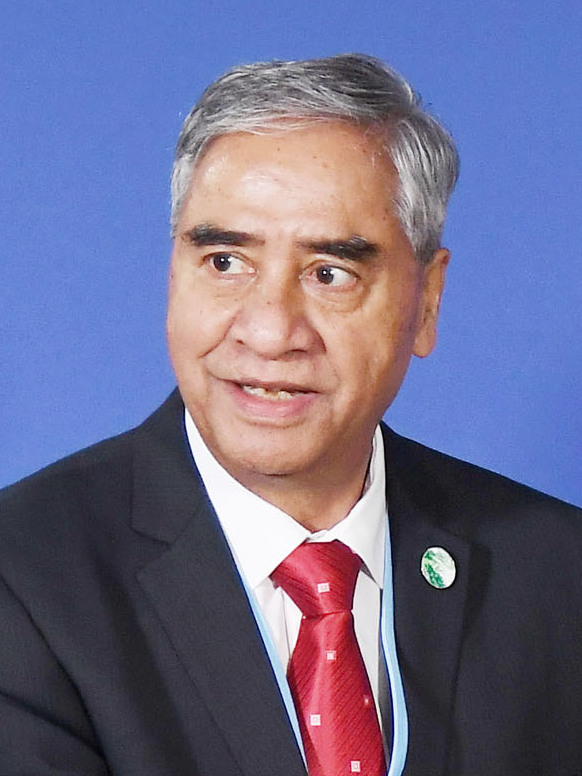 4.2
4.2Sher Bahadur Deuba
Senior leader and former President, Nepali Congress; five-time former Prime Minister; opposition (party heavily defeated in the March 2026 election)
 4.0
4.0KP Sharma Oli
CPN-UML Party Chairman (party lost the March 2026 election; not a member of the 7th House)


Active Executive holds power now (PM + cabinet) — under accountability watch. Democratic Transition led the interim handover. Opposition is judged on scrutiny quality, not noise. Future Pool surfaces emerging and sector talent before fame finds them.
How we evaluate
Six separate measures — never one number
Collapsing everything into a single rank rewards fame. We score five judgement measures and keep Relevance separate — a controversial figure can be highly relevant yet low on credibility. Risk flags are shown apart from the scores, never blended in.
Credibility
Truthful, ethical, transparent, evidence-backed.
Competence
Understands law, budgets, institutions, teams, delivery.
Delivery
Has actually completed work — not just spoken well.
Democratic character
Respects courts, press, rights, due process, peaceful transfer.
Realism
Promises possible within law, budget, time, and state capacity.
Relevance
How much they currently matter — shown apart, not a moral score.
Origin of legitimacy
Every profile records how a leader became visible — democracy struggle, civil-rights work, electoral mandate, public-service delivery, professional competence, movement leadership, local community work, diaspora expertise, or a media-driven rise.
Origin explains how they became visible. It does not automatically prove leadership quality.
Risk flags — kept separate
Flags require evidence. We never call a person corrupt, fake, or a propagandist without court, audit, or official record — and every named figure has a right of reply.
In plain words
A leader is not good just because many people know their name, or because they speak loudly, or because they were important in the past. A good leader tells the truth, respects people, makes realistic plans, uses money properly, and finishes the work — and you can check all of it.
Scores change when evidence changes. Every change is panel-reviewed and archived.
Full methodology →