
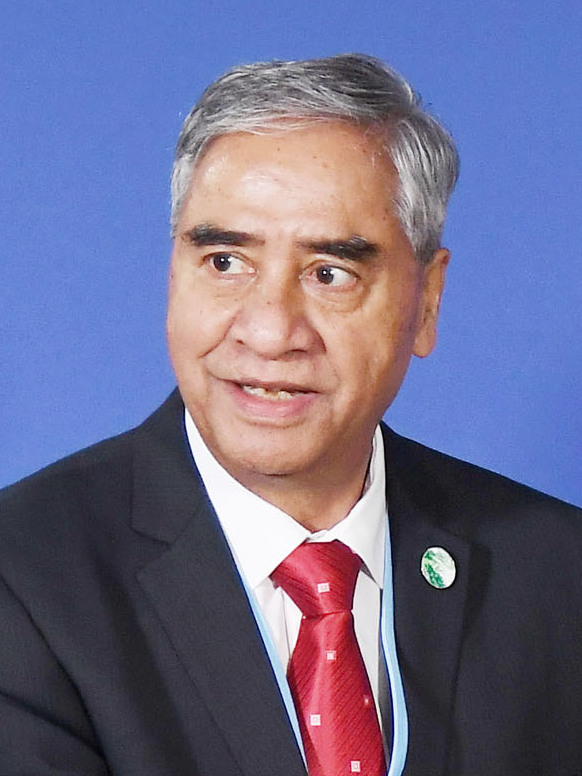
Sher Bahadur Deuba
being replaced by the six measures
This is a live intelligence profile. Deuba's legal proceedings have a complex status. Nepal Next does not pre-judge ongoing cases.
Leadership assessment
Under reviewSix separate measures — never one number. The shape is the signature: tap any measure for the band, the reasoning, and the evidence behind it.
Relevance · how much they shape events now
Kept apart from the signature. Not a moral score; a figure can be highly relevant and low on credibility.
As the senior leader and former president of the Nepali Congress, a major opposition party, he retains meaningful influence over national politics despite his party's recent electoral defeat.
Drafted from the verified record and awaiting panel review at medium confidence. Rings mark the rubric bands. Tap any measure for the reasoning and the evidence behind it. Scores change when the evidence changes.
Executive accountability · power-holder checks
Parliament accountability
Under review · from the record below
Team integrity
Under review · from the record below
Landlocked statecraft
Under review · from the record below
Origin of legitimacy
Not yet recorded
Origin explains how they became visible — not whether they are good.
Risk flags · kept separate
None recorded with evidence
Scores are evidence-based, panel-reviewed, and change when evidence changes.
Track record
- 2021: Deuba was appointed Prime Minister for his fifth term on July 13, 2021, following a Supreme Court order.source ↗
- He earned degrees in Humanities and Law from Tri-Chandra College, affiliated with Tribhuvan University.source ↗
- 2021: His government managed 10.5 million COVID-19 vaccine doses and fully vaccinated 32.6% of the targeted group within its first 100 days.source ↗
- He declared a state of emergency and listed the Communist Party of Nepal (Maoist) as a "terrorist organization" during his second term.source ↗
- The Maoist insurgency began during his first prime ministerial term.source ↗
- Deuba implemented a system for voter identification cards and worked to end dual land ownership.source ↗
- 2022: Deuba's government approved approximately 900 billion rupees worth of investment for 33 projects, with a majority focused on green and clean energy.source ↗
- Deuba introduced pensions, allowances, and other privileges for legislators.source ↗
- 2021: Deuba was re-elected President of the Nepali Congress at the 14th convention in December 2021.source ↗
- 2021: Deuba claimed successful "vaccine diplomacy" and management of 10.5 million COVID-19 vaccines.source ↗
- 2021: Deuba's government achieved 32.6% of the targeted population fully vaccinated by October 2021.source ↗
- Deuba introduced Value-added Taxes.source ↗
In the historical record
Turning points this leader shaped, or that shaped them.
Who they are
Sher Bahadur Deuba was born in 1946 in Dadeldhura district, Sudurpaschim province. He is the longest-serving president of the Nepali Congress, Nepal's oldest democratic party. He has served as Prime Minister five times: 1995–97, 2001–02, 2004–05, 2017–18, and 2021–22. He was unconstitutionally dismissed by King Gyanendra in 2002 and was reinstated by the Supreme Court. He is a symbol of Nepal's democratic continuity but also of its elite political dynasties.
शेरबहादुर देउवा सन् १९४६ मा डडेलधुरा जिल्लामा जन्मिएका हुन्। उनी नेपाली काँग्रेसका सबैभन्दा लामो समय पार्टी सभापति बन्ने व्यक्ति हुन् र पाँचपटक प्रधानमन्त्री भइसकेका छन्।
Public Record
What they promised
Multiparty democracy and constitutional governance throughout his career. In each of his prime ministerial tenures: economic development, civil service reform, poverty reduction, press freedom, and federalism implementation.
Delivery Record
Nepali Congress has been a consistent defender of multiparty democracy during Nepal's multiple constitutional crises. Deuba signed the Comprehensive Peace Agreement framework document in his capacity as PM (2006). His fifth term (2021–22) oversaw MCC Compact ratification. However, five prime ministerial terms with limited structural economic reform is a pattern critics note consistently.
Strengths & Weaknesses
Strengths
Deep party roots. Institutional knowledge of Nepal's parliamentary system. Seen as a democratic anchor — less likely than communist parties to dissolve parliament. Strong in Sudurpaschim province. History of surviving political crises.
Weaknesses
Age (born 1946 — 79 years old in 2025). Seen as representative of old-guard politics. Party's youth wing has a separate agenda from party leadership. Corruption allegations (acquitted in some cases, other cases unresolved — see controversies). Limited vision on economic transformation.
Legacy score breakdown
An earlier single-composite model, kept for continuity. It is being replaced by the six separate measures above.
Transparency, ethical conduct, financial accountability
Domain expertise, qualifications, proven ability
Delivery on stated promises and measurable results
Clarity and credibility of long-term direction
Demonstrated citizen confidence based on evidence
Relevance and credibility with voters under 35
Specificity and realism of policy positions
Current reach and impact across Nepal
Future Relevance
Deuba's future relevance is as party president and coalition broker, not as a future prime minister. Nepal's political system may require a Nepali Congress-led coalition after March 2026. His successor question — who leads Nepali Congress after Deuba — is one of the most significant unknowns in Nepal's near-term politics.
Relevance to Young Nepal
Low. Deuba is 79 in 2025. He represents the old-guard democratic establishment. The Nepali Congress has significant youth membership but the generational gap between party leadership and younger members is a recognised internal tension. The September 2025 protests targeted the establishment broadly, and Nepali Congress — despite supporting democratic norms — is seen as part of that establishment.
Long-term Impact
Five prime ministerial terms make Deuba one of Nepal's most experienced democratic politicians. His consistent defence of multiparty democracy — surviving two unconstitutional royal dismissals — is his clearest institutional contribution. His economic legacy is weaker: after five terms, Nepal's structural transformation remains limited and corruption accountability incomplete.
What could change this profile
NC's internal succession question is now urgent after the March 2026 defeat. Leadership transition within NC would be a major development. Whether Deuba leads opposition or steps back.
Profile Details
- Entered politics
- 1970
- Photo
- Photo: Prime Minister's Office, via Wikimedia Commons · GODL-India
Political Journey
- 1970
Student political activist
Nepali Congress
Active in Sudurpaschim province
- 1991
Member of Parliament
Nepali Congress
First elected after democracy restoration 1990. Represented Dadeldhura. [VERIFIED — Election Commission]
- 1995
Prime Minister (1st term)
Nepali Congress
Minority government. Led to peace talks with Maoists (Suryodaya Agreement). [VERIFIED]
- 2001
Prime Minister (2nd term)
Nepali Congress
Led government during start of Maoist escalation. Declared State of Emergency. [VERIFIED]
- 2002
Dismissed unconstitutionally
Nepali Congress
Dismissed by King Gyanendra. Later reinstated by Supreme Court. [VERIFIED]
- 2004
Prime Minister (3rd term)
Nepali Congress
Led government under palace pressure. Dismissed again by King 2005. [VERIFIED]
- 2017
Prime Minister (4th term)
Nepali Congress
Led left alliance defeat; 2017 elections. [VERIFIED]
- 2021
Prime Minister (5th term)
Nepali Congress
Appointed by Supreme Court order after Oli's second unconstitutional dissolution. Oversaw MCC ratification, 2022 elections. [VERIFIED]
- 2022
Opposition Leader
Nepali Congress
Nepali Congress contested 2022 elections, performed better than polls suggested. Led coalition discussions.
- 2024
Joined coalition government
Nepali Congress
Nepali Congress joined Oli-led coalition government. Deuba remains party president.
- 2026
Party President, Nepali Congress
Nepali Congress
Party performed in March 2026 elections. Leading coalition government formation discussions.
Score History